
Your baby
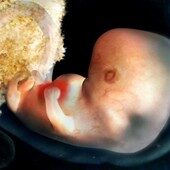
A tiny grain of rice about two millimetres long — that is what your baby most resembles now. Yet a great deal is going on inside that grain of rice. This week the heart begins to form: an important moment.
Sometimes a fertilised egg splits into two, each forming an embryo of its own. You then have identical twins. Such twins are always of the same sex, look strikingly alike and have the same hereditary characteristics. If two eggs ripen instead of one, are released at the same time and are both fertilised, you have non-identical twins. They can be of different sexes and can look completely different. A curious fact: non-identical twins often run in families, while identical twins are always chance.
You
Now that you are pregnant, living healthily matters all the more. Not only are alcohol and smoking forbidden fruit; you should also leave soft cheeses made from raw milk alone for now. They can carry the listeria bacterium, which is harmful to your baby. You can recognise these cheeses by the words 'au lait cru' on the label.
Go easy on vitamin A as well, because too much of it is not good for your baby. So do not eat much offal, such as liver and kidneys, as these are rich in vitamin A. It is also better to avoid raw meat such as steak tartare, which can carry the toxoplasmosis parasite. And let someone else change the cat's litter tray, for the same reason.
Going to the sauna is not wise early in pregnancy either. Large swings in temperature are not good in exactly the period when the organs are forming.
Taking folic acid
Are you already taking folic acid? Take 0.4 or 0.5 milligrams a day and carry on until you are 10 weeks pregnant. Folic acid reduces the chance of your baby being born with spina bifida or another condition of the central nervous system.
Taking vitamin D
When you are pregnant you need extra calcium to build your baby's bones, and vitamin D is needed to make enough calcium available. The Health Council therefore advises all pregnant women to take 10 micrograms of vitamin D a day, even if you are outdoors a lot and eat healthily.
Moeders voor Moeders
During the first four months of pregnancy your body produces the unique hormone hCG in abundance. What you do not use, you pass in your urine and it simply disappears down the toilet. A shame, because for some women this hormone is essential in order to conceive at all: a medicine used in fertility treatment is made from it. The organisation Moeders voor Moeders (in Dutch) collects the urine of pregnant women. If you would like to take part, you can register from now on. Our registration form asks whether we may pass your details on to them.